

Style
Chebe Powder
Aug
Chebe Powder: The Traditional African Hair Care Secret for Length Retention and Healthy-Looking Hair
Discover the rich heritage of Chebe Powder, its traditional uses, and why this botanical hair care ingredient has become a favorite among natural hair enthusiasts.
Across Africa, generations of women have relied on botanical ingredients and traditional hair care techniques to maintain and care for their hair.
From nourishing plant oils to carefully prepared herbal blends, these beauty traditions reflect a deep understanding of hair care passed down through families and communities.
One particularly fascinating ingredient is Chebe Powder, a traditional Chadian hair care preparation that has attracted growing interest among people seeking natural approaches to maintaining healthy-looking hair.
Known for its use in traditional hair-length retention practices, Chebe Powder has become increasingly popular among individuals with curly, coily, and textured hair.
But what exactly is Chebe Powder? Does it help hair grow? And how can you incorporate it into your hair care routine?
Let’s explore the history, traditional benefits, and practical uses of this remarkable African hair care ingredient.
What Is Chebe Powder?
Chebe Powder is a traditional botanical hair care preparation associated with communities in Chad, particularly women of the Basara ethnic group.
It is traditionally made from a blend of dried and ground plant materials, seeds, and aromatic ingredients.
Recipes can vary by community, producer, and family tradition.
One of the commonly identified ingredients is the seed of Croton zambesicus, a plant found in parts of tropical Africa.
Other traditional preparations may include ingredients such as cloves and additional aromatic botanical materials.
The ingredients are typically processed into a fine or slightly coarse powder, which is then incorporated into traditional hair care mixtures.
Chebe Powder is generally used along the hair shaft rather than directly on the scalp.
Its traditional application often involves combining the powder with water, oils, or conditioning ingredients and applying the mixture to sections of hair before braiding.
Why Is Chebe Powder So Popular?
Chebe Powder has gained international attention largely because of the longstanding hair care practices associated with women in Chad.
Traditional Chebe routines often combine botanical preparations, moisture, and protective styling.
These techniques are especially interesting to individuals with tightly curled or coily hair, which may be more vulnerable to breakage during detangling and manipulation.
The popularity of Chebe Powder reflects growing interest in traditional African beauty knowledge and hair care practices that prioritize maintaining existing hair length.
However, it is important to understand that the effects of Chebe Powder itself have not been extensively studied in controlled human clinical trials.
Many of its widely discussed benefits are based on traditional experience rather than established scientific evidence.
7 Traditional Benefits and Uses of Chebe Powder for Hair
1. Traditionally Used to Support Length Retention
One of the most frequently discussed benefits of Chebe Powder is its association with hair length retention.
Hair grows naturally from follicles within the scalp, but the length we see depends partly on how much of that hair remains intact over time.
When hair breaks repeatedly, it can appear as though it is not growing.
Traditional Chebe routines emphasize coating the hair, maintaining moisture, and keeping the strands in protective styles.
These practices may help reduce mechanical damage when performed gently.
Although Chebe Powder has not been clinically proven to prevent breakage, the broader practice of reducing unnecessary manipulation can support length retention.
2. Complements Moisture-Retention Routines
Moisture management is especially important for curly, coily, and tightly textured hair.
Because of the shape and structure of these hair types, natural scalp oils may not distribute as easily along the entire hair shaft.
Traditional Chebe preparations are frequently combined with oils, butters, or other conditioning ingredients.
These ingredients can help lubricate the hair and reduce moisture loss.
It is important to note that Chebe Powder itself is not a moisturizer.
The conditioning effects of a Chebe mixture depend largely on the other ingredients used and the overall hair care routine.
3. Encourages Gentle, Low-Manipulation Hair Care
Traditional Chebe routines often involve sectioning the hair and placing it into braids or other protective styles.
Keeping hair in manageable sections may reduce daily brushing, combing, and styling.
Less frequent manipulation can be beneficial for hair that is prone to tangling or mechanical breakage.
However, protective styles should never be excessively tight, as repeated tension can damage the hair and contribute to traction alopecia.
Chebe Powder can be incorporated into a gentle hair care routine that prioritizes comfort and minimizes unnecessary tension.
4. May Help Improve Hair Manageability When Blended With Conditioners
Chebe Powder is often mixed with oils, butters, or conditioning products before application.
These combinations may make hair easier to separate, braid, and maintain.
Improved manageability can be particularly helpful for individuals with thick, curly, or coily hair.
The smoother feel associated with these preparations is generally attributable to the conditioning ingredients and lubrication they provide.
For best results, avoid applying large amounts of dry powder directly to the hair, as this may cause buildup or make detangling more difficult.
5. Can Be Incorporated Into Protective Styling
Protective styling is an important part of many traditional African hair care routines.
Chebe preparations are commonly used on sections of hair before braiding.
When braids are installed loosely and maintained appropriately, they can help reduce repeated handling of the hair.
This approach may be useful for individuals who want to maintain their natural hair while minimizing daily styling.
Remember that protective styles still require regular cleansing, scalp care, and attention to signs of tension or discomfort.
6. Offers a Botanical Addition to Natural Hair Care
Chebe Powder appeals to individuals who enjoy incorporating traditional botanical ingredients into their beauty routines.
Depending on the formulation, Chebe preparations may contain a combination of seeds, herbs, and aromatic plant materials.
These ingredients contribute to the powder’s distinctive appearance, texture, and scent.
However, botanical ingredients are not automatically suitable for everyone.
Because Chebe recipes vary, individuals should review the ingredient list and patch test new products before use.
7. Celebrates African Hair Care Heritage
Beyond its practical uses, Chebe Powder represents a meaningful connection to traditional African hair care.
Its history is closely associated with women in Chad who have maintained distinctive hair care practices across generations.
These traditions reflect cultural knowledge, community identity, and techniques developed through experience.
Today, the growing interest in Chebe Powder provides an opportunity to recognize and appreciate the cultural heritage behind this botanical preparation.
Understanding its origins is an important part of appreciating the ingredient itself.
Does Chebe Powder Actually Make Hair Grow Faster?
This is one of the most common questions about Chebe Powder.
The short answer is that there is currently insufficient scientific evidence that Chebe Powder increases the rate of hair growth.
Hair growth occurs within follicles in the scalp and is influenced by several factors, including genetics, hormones, nutrition, age, and overall health.
Chebe Powder is traditionally applied to the hair shaft rather than used as a scalp treatment.
Its reputation is more closely associated with maintaining hair length than stimulating new growth.
This distinction is important.
Hair growth refers to the production of new hair from the follicle.
Length retention refers to preserving the hair that has already grown by reducing breakage and damage.
A hair care routine that reduces breakage may help hair appear longer over time, even without changing its natural growth rate.
How to Use Chebe Powder for Natural Hair
Chebe Powder is traditionally used as part of a hair care mixture rather than applied as a dry powder.
Here is a simple approach inspired by traditional Chebe routines.
Step 1: Start With Clean, Detangled Hair
Begin with freshly cleansed hair that has been gently detangled.
Slightly damp hair may be easier to section and manage.
Step 2: Prepare a Chebe Hair Mixture
Combine a small amount of Chebe Powder with a suitable hair conditioner or a conditioning oil.
For an initial trial, you can use:
- 1 teaspoon of Chebe Powder
- 2 tablespoons of your preferred hair conditioner
Mix thoroughly until the powder is evenly distributed.
This is a simple home-use preparation rather than a clinically tested formula.
Step 3: Divide Hair Into Sections
Separate your hair into manageable sections.
This helps distribute the mixture more evenly and reduces unnecessary tangling.
Step 4: Apply to the Hair Lengths
Apply a small amount of the mixture along the hair strands, concentrating on the mid-lengths and ends.
Avoid direct application to the scalp, eyes, and broken or irritated skin.
Step 5: Style Gently
Place the treated sections into loose braids or twists, if desired.
Avoid pulling tightly at the roots or using styles that create discomfort.
Step 6: Rinse and Maintain Your Hair
For first-time use, rinse the mixture out thoroughly after a short trial period, following any instructions provided by the product manufacturer.
Traditional Chebe preparations may be left on the hair for longer periods, but this does not establish that extended wear is appropriate for every formulation.
Continue your regular cleansing and conditioning routine to prevent buildup.
How Often Should You Use Chebe Powder?
There is no scientifically established ideal frequency for Chebe Powder application.
The appropriate frequency depends on your hair type, the product formulation, and how your hair responds.
For beginners, occasional use is a reasonable starting point.
Pay attention to how easily your hair can be cleansed and detangled afterward.
If the mixture causes excessive buildup, dryness, irritation, or increased tangling, reduce the frequency or discontinue use.
Is Chebe Powder Suitable for All Hair Types?
Chebe Powder is especially associated with traditional care for tightly curled and coily hair.
However, people with different hair textures may choose to explore it.
For fine or low-density hair, heavy mixtures containing powder, oils, and butters may weigh the hair down.
For tightly textured hair, a well-formulated conditioning mixture may be easier to incorporate into sectioning and protective styling.
Individual results vary, and there is no reliable clinical evidence that Chebe Powder works better for one specific hair type.
Can Chebe Powder Be Applied to the Scalp?
Traditional Chebe preparations are generally applied to the hair strands rather than directly to the scalp.
This is an important distinction because the powder may contain aromatic botanical materials that can irritate sensitive skin.
Applying it directly to the scalp may also contribute to residue buildup.
For these reasons, it is generally preferable to keep Chebe mixtures away from the scalp unless a finished product has been specifically formulated and evaluated for scalp use.
Chebe Powder vs. Other Natural Hair Care Ingredients
Chebe Powder is sometimes compared with other popular botanical hair care ingredients, including henna, amla, and shea butter.
However, these ingredients serve different purposes.
Chebe Powder: Traditionally incorporated into hair-length retention and protective styling routines.
Henna: A botanical dye that can color hair and may affect the feel of the hair shaft.
Amla Powder: A botanical ingredient used in traditional Indian hair care preparations.
Shea Butter: An emollient ingredient that helps lubricate and condition hair, depending on the formulation.
Rather than treating these ingredients as interchangeable, it is more useful to understand their individual properties and intended applications.
How to Store Chebe Powder
Proper storage helps maintain the quality of botanical powders.
Keep Chebe Powder in a tightly sealed container away from moisture, direct sunlight, and excessive heat.
Always use a clean, dry spoon when removing powder from the container.
Avoid introducing water into the stored powder, as moisture can encourage microbial growth.
If you prepare a Chebe mixture using water or conditioner, make only the amount needed for immediate use unless the formulation has been appropriately preserved and tested.
Choosing Quality Chebe Powder
When shopping for Chebe Powder, consider the following:
- Ingredient transparency: Look for a clearly identified ingredient list.
- Product quality: Choose powders intended for cosmetic or hair care applications.
- Texture: Consider how finely the powder is milled and whether it is suitable for your preferred preparation.
- Packaging: Select products packaged to protect against moisture and contamination.
- Supplier information: Look for brands that provide clear product descriptions and usage guidance.
Because traditional Chebe recipes vary, not all products sold as Chebe Powder contain exactly the same ingredients.
Understanding the composition of your product is essential, particularly if you have allergies or sensitive skin.
The Cultural Heritage Behind Chebe Powder
The story of Chebe Powder is closely connected to the hair care traditions of women in Chad.
For generations, traditional botanical preparations and carefully maintained hairstyles have formed part of personal care and cultural expression.
These practices reflect more than cosmetic preferences. They represent knowledge passed down through communities and families.
As Chebe Powder becomes increasingly popular internationally, it is important to recognize the people and traditions from which it originates.
Appreciating Chebe Powder means appreciating its cultural history alongside its modern uses.
Rediscover Traditional African Hair Care With Ariya Organics
Healthy-looking hair is not simply about how quickly it grows. It is also about how well it is cared for, protected, and maintained.
Chebe Powder offers a fascinating introduction to traditional African hair care practices that emphasize conditioning, gentle handling, and length retention.
While more scientific research is needed to establish its specific effects, its cultural significance and traditional applications continue to inspire natural hair care enthusiasts around the world.
At Ariya Organics, we celebrate the beauty of botanical ingredients and the rich heritage of African personal care traditions.
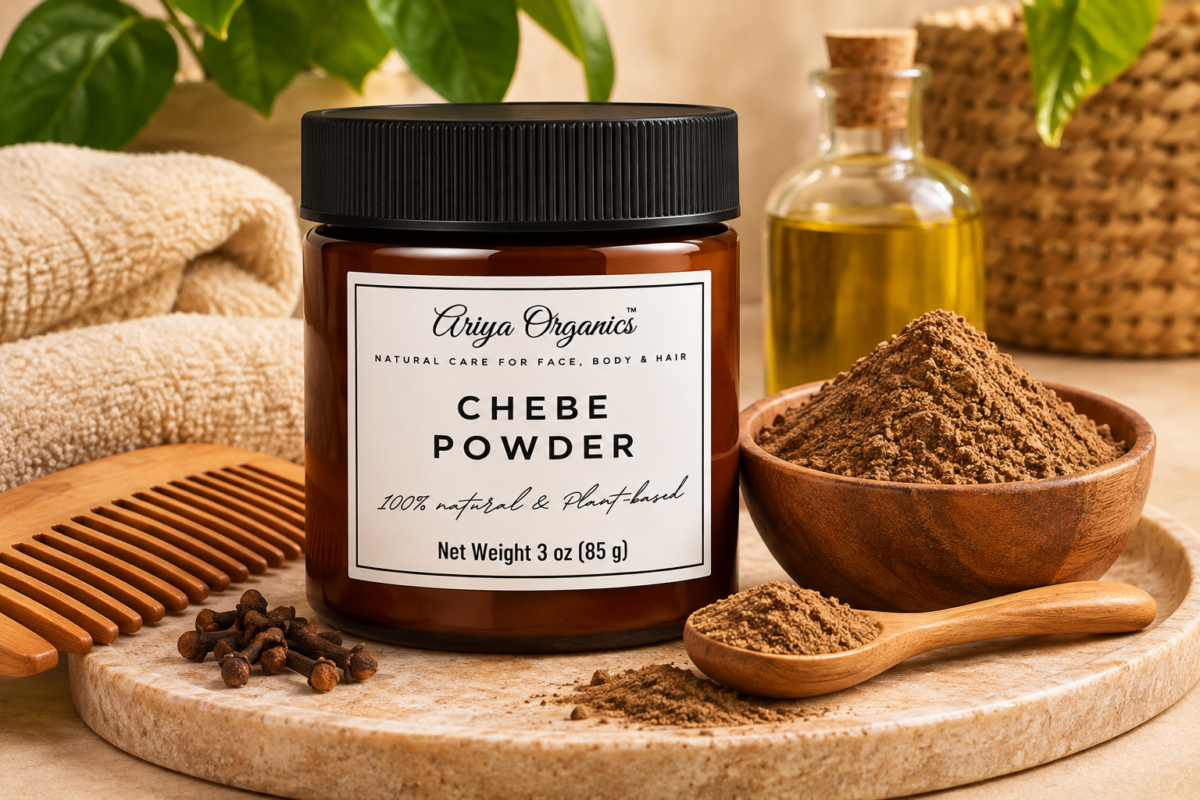
Explore Ariya Organics Chebe Powder and discover a botanical ingredient rooted in generations of African hair care knowledge.
Frequently Asked Questions About Chebe Powder
Does Chebe Powder grow hair?
There is insufficient clinical evidence that Chebe Powder stimulates hair follicles or accelerates hair growth. It is traditionally associated with length-retention practices.
Can Chebe Powder be used on natural hair?
Yes. Chebe Powder is traditionally used in preparations for natural, textured hair. Its suitability depends on the ingredients, formulation, and individual hair needs.
Can I leave Chebe Powder in my hair overnight?
Some traditional preparations are worn for extended periods. However, the safety and suitability of overnight use depend on the specific formulation. Follow the product’s instructions and avoid extended wear when trying a new mixture.
Can Chebe Powder be mixed with shea butter?
Yes. Chebe Powder is sometimes combined with shea butter or other conditioning ingredients. Shea butter contributes emollient properties that can help lubricate the hair.
Is Chebe Powder good for low-porosity hair?
There is no strong clinical evidence establishing specific benefits for low-porosity hair. Heavy Chebe mixtures may cause buildup, so begin with small amounts.
Does Chebe Powder prevent hair breakage?
Traditional Chebe routines are associated with length retention, but direct clinical evidence that Chebe Powder itself prevents breakage is limited. Gentle handling, conditioning, and reducing excessive tension are important for minimizing mechanical damage.
Can Chebe Powder be used on relaxed hair?
Some individuals may incorporate Chebe Powder into routines for chemically treated hair, but the effects have not been well studied. Chemically treated hair may be fragile, so use caution and test a small section first.
